Understanding the Role of an Applicator Roller in Industrial Operations
Admin
Article Content
The quality of products in today's manufacturing industry depends heavily on precision and consistency.Many manufacturing sectors, including coating, laminating, and so on, require specialized equipment for accurate results. Applicator Roller can coat an even layer of a variety of materials across surfaces.
Incorporating Applicator Roller in the manufacturing process improves productivity by maintaining uniformity and consistency of the products. They are relevant in many sectors such as textile, paper, plywood, packaging, and steel.
Incorporation of modern manufacturing processes in industries leads to the increased need for sourcing high quality roller solutions. Indian Roller Industries Pvt. Ltd is one such company that focuses on developing reliable roller technologies to satisfy the demands of varied industries.
What is an Applicator Roller?
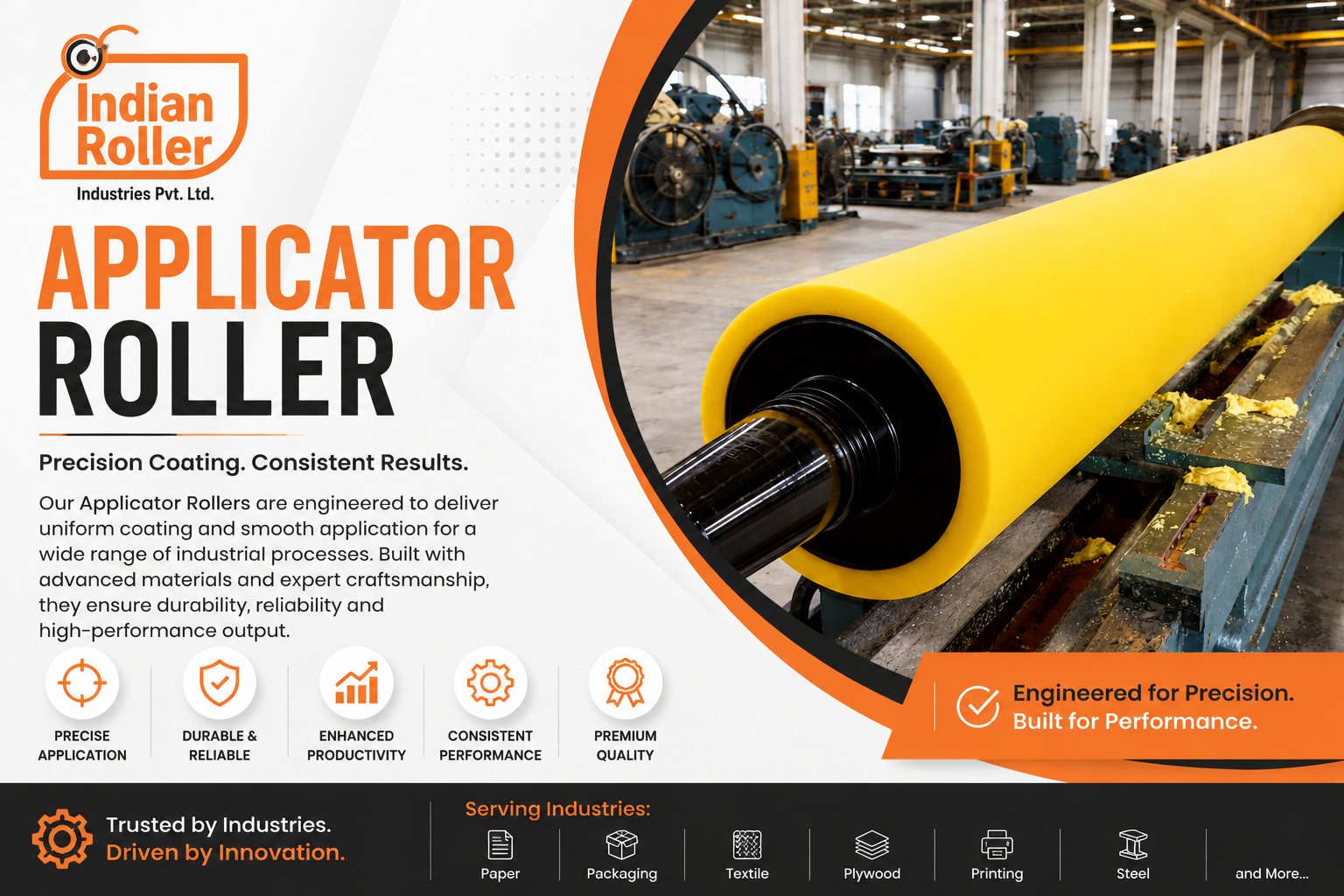
An Applicator Roller is an industrial roller designed for application of measured amounts of liquids, adhesives, coatings, inks, or chemical solutions to specific surfaces. They are used for smooth dispersion of solution in order to assist manufacturers achieve uniformity in their manufacturing process.
Applicator Roller is primarily manufactured using rubber, polyurethane, and/or special compounds that are specifically chosen to suit operational needs. This type of construction is used when exposure to a wide range of temperatures, pressures, and/or chemicals is anticipated.
The main goals of them are even coating without surplus, streaking, or unevenness.
Importance of Applicator Roller in Industrial Operations
Manufacturing industries demand accuracy and consistency. Coating and adhesive application variations even of a fraction of a millimeter can lead to defective final products.
An Applicator Roller helps eliminate these challenges by ensuring:
Uniform material distribution
Improved surface quality
Reduced material wastage
Enhanced production speed
Better process control
Consistent product performance
Without proper application systems, industries may experience defects, uneven finishes, increased rejection rates, and higher operational costs.
How an Applicator Roller Works
The working principle of an Applicator Roller is straightforward yet highly effective.
The roller moves through a supply system containing coating material. With each rotation, the roller deposits a set amount of coating onto the surface that the roller contacts.
The process generally involves:
Material collection from the supply source
Metering of excess material
Uniform transfer to the substrate
Controlled pressure application
Consistent coating formation
This precise mechanism ensures that every section of the product receives the required amount of material.
Key Components of an Applicator Roller System
A complete roller application system typically includes several important elements:
Component | Function |
Roller Core | Provides structural strength and stability |
Cover Material | Ensures proper material transfer |
Bearings | Enable smooth rotation |
Coating Supply System | Delivers material to the roller |
Pressure Control Mechanism | Maintains uniform application |
Drive System | Controls rotational speed |
Each component contributes to the overall efficiency and effectiveness of the application process.
Types of Applicator Roller Used in Industries
Different industrial operations require different roller configurations.
Rubber-Coated Rollers
The flexibility and superior surface contact from rollers that are covered in rubber mean that these rollers are extensively used in the field of printing, packaging and textiles.
Polyurethane Rollers
Polyurethane rollers offer superior wear resistance and long service life. They are commonly selected for demanding industrial environments.
Grooved Rollers
These rollers contain specially designed grooves that assist in controlled liquid transfer and precise coating applications.
Smooth Surface Rollers
Smooth rollers are used where highly uniform coating distribution is required.
Chemical-Resistant Rollers
Designed for harsh operating conditions, these rollers can withstand aggressive chemicals and solvents.
Industries That Depend on Applicator Roller
The versatility of an Applicator Roller allows it to serve numerous industrial sectors.
Paper Industry
Paper manufacturers use rollers for coating applications that improve printability, durability, and surface finish.
Packaging Industry
Packaging operations rely on roller systems for adhesive application, lamination, and surface treatments.
Textile Industry
Textile manufacturers utilize rollers to apply dyes, finishing chemicals, and protective coatings.
Plywood Industry
Rollers help distribute adhesives evenly during plywood production, ensuring strong bonding performance.
Steel Industry
In steel processing plants, rollers assist in applying protective coatings and treatment chemicals.
Printing Industry
Printing operations use roller systems for accurate ink transfer and consistent image quality.
Benefits of Using an Applicator Roller
The widespread adoption of the Applicator Roller is driven by several operational advantages.
Enhanced Product Quality
Uniform application helps maintain consistent product standards across large production volumes.
Increased Production Efficiency
Roller systems support continuous manufacturing processes, reducing downtime and increasing output.
Reduced Material Consumption
Controlled application minimizes waste and improves material utilization.
Better Process Stability
Manufacturers can achieve repeatable results with improved process control.
Lower Maintenance Costs
Modern roller designs offer excellent durability, reducing replacement frequency and maintenance expenses.
Improved Surface Finish
Accurate coating application results in smoother and more attractive finished products.
Factors to Consider When Selecting an Applicator Roller
Indian Roller Industries Pvt. Ltd provide huge variety so, Choosing the right roller requires careful evaluation of several operational parameters.
Material Compatibility
The roller covering should be compatible with the chemicals, adhesives, or coatings being used.
Operating Temperature
Temperature resistance is critical in high-heat manufacturing environments.
Surface Characteristics
The surface texture influences coating accuracy and transfer efficiency.
Load Requirements
The roller must withstand operational pressure without deformation.
Chemical Resistance
Exposure to solvents and chemicals requires appropriate cover materials.
Production Speed
Rollers should maintain performance even under high-speed operating conditions.
Common Challenges and Solutions
While highly effective, roller systems can experience certain operational issues.
Challenge | Solution |
Uneven Coating | Proper roller alignment |
Excess Material Usage | Accurate pressure adjustment |
Surface Marks | Regular maintenance and cleaning |
Roller Wear | Use of durable cover materials |
Coating Inconsistency | Routine inspection and calibration |
Addressing these issues promptly helps maintain productivity and product quality.
Maintenance Practices for Long-Term Performance
Regular maintenance significantly extends roller lifespan and improves operational efficiency.
Important maintenance practices include:
Routine cleaning after production cycles
Inspection for surface damage
Monitoring roller hardness
Checking bearing condition
Verifying alignment settings
Replacing worn components when necessary
A preventive maintenance approach reduces unexpected downtime and improves reliability.
Future Trends in This Technology
Industrial automation and advanced manufacturing are driving innovation in roller technology.
Emerging developments include:
Smart monitoring systems
Enhanced polyurethane formulations
Improved wear-resistant surfaces
Automated pressure control systems
Precision coating technologies
Energy-efficient manufacturing solutions
These advancements are helping industries achieve greater productivity and quality standards.
Conclusion
Modern industrial operations depend on the Applicator Roller to rely on the accurate, consistent and efficient application of materials. These rollers have a considerable impact on the quality of production and the profitability of operations across a wide range of industries, from manufacturing paper and packaging to textiles and even steel and plywood.
The Applicator Roller is a prized piece of technology in an industrial production system, because it helps make a coating uniformly, which also reduces the waste of materials and provides a mechanism for uninterrupted manufacturing. Roller technology will become an even more crucial part of manufacturing if the various industries pursue manufacturing that is increasingly more efficient and produces materials with even more quality.
Frequently Asked Questions (FAQs)
1. What is the primary function of them?
The primary function of an Applicator Roller is to apply coatings, adhesives, chemicals, inks, or liquids evenly across a surface during manufacturing.
2. Which industries commonly use these types of Roller?
Paper, packaging, textile, steel, plywood, printing, and various processing industries regularly use these rollers.
3. What materials are used to manufacture Applicator Roller?
Common materials include rubber, polyurethane, and specialized compounds designed for specific industrial applications.
4. How does an Applicator Roller improve production efficiency?
It provides consistent material application, reduces waste, minimizes defects, and supports continuous production processes.
5. How often should an Applicator Roller be maintained?
Maintenance schedules vary by application, but regular inspection, cleaning, and performance checks are recommended for optimal operation.
6. Can this Roller handle chemical coatings?
Yes. Specialized roller coverings are designed to resist chemicals and maintain performance in demanding environments.
7. What factors affect the lifespan of an Applicator Roller?
Material quality, operating conditions, maintenance practices, temperature exposure, and chemical contact all influence roller lifespan.