Pinch Roller
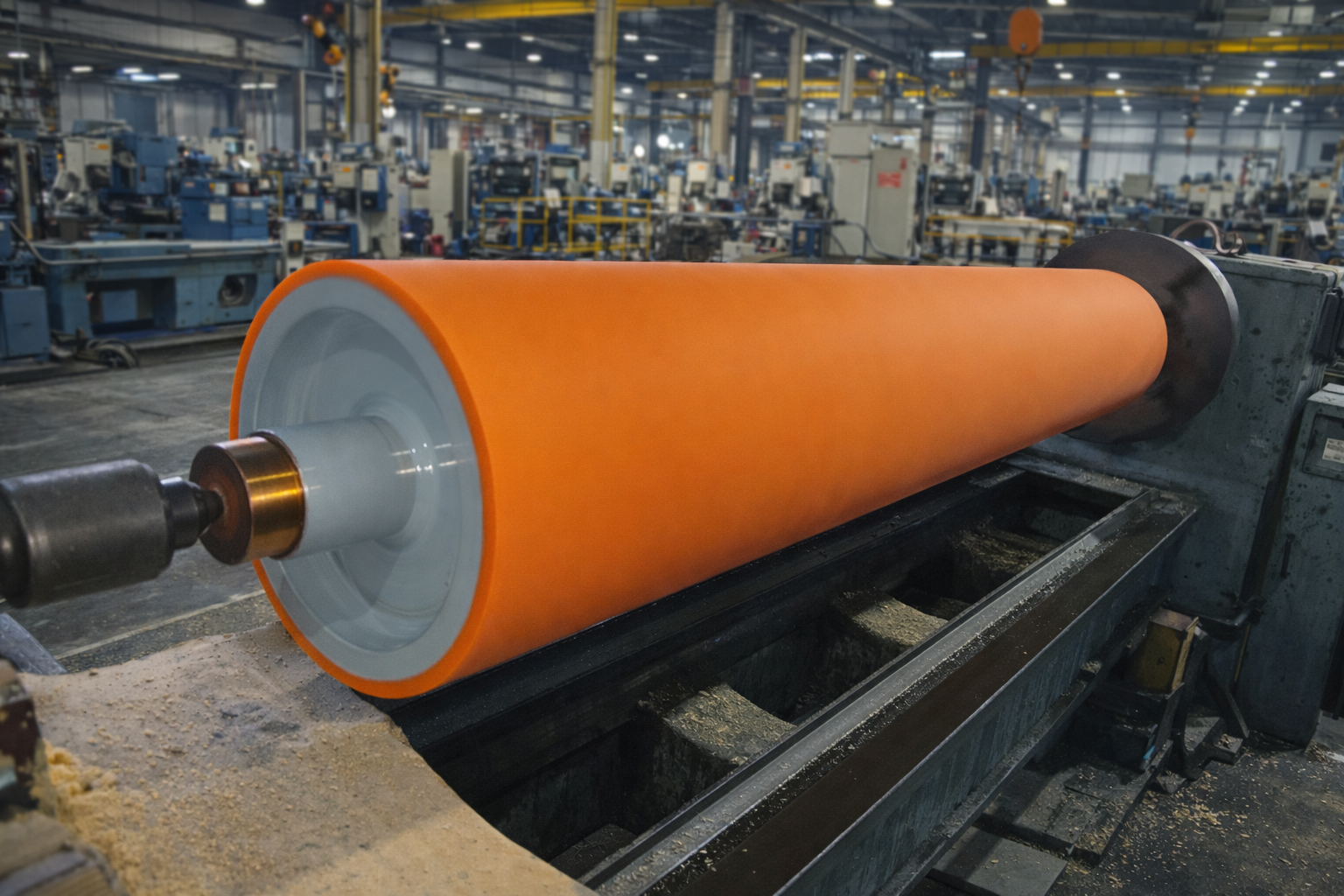
Product Overview
Pinch Rubber Roller
In contemporary industrial processing, it is necessary to maintain a healthy tension and grip as well as control over materials to ensure quality production. A Pinch Roller is a very sensitive tool that is applied in different industries to direct, press and manage materials that pass through machines. This Pinch Rubber Roller is used to feed and position materials properly whether in steel plants, textile units, paper mills or converting lines.
This equipment is made to accommodate heavy loads and repeated operations, which is critical in enhancing efficiency and minimizing wasteful materials. Through appropriate design and engineering, it is possible that industries can have an enhanced productivity and increased service life of their machinery.
What Is a Pinch Roller?
A Pinch Roller is a cylindrical roller that is industrial in nature, and that is used to hold and direct materials like metal sheets, wires, fabrics, films, or paper when processing. It is achieved by pressing the material with controlled pressure between two rollers or a roller against a surface and hence provides a stable and accurate movement of the material.
The roller surface is covered with rubber or special compounds to increase the friction and eliminate slipping. A Pinch Rubber Roller is mostly preferred in most applications due to its better grip, shock absorption, and wear ability.
How It Works in Industrial Applications
Pinch Roller This process works by pushing the material between two rotating parts. The movement is propelled by one roller and the pressure is applied by the other in order to ensure the grip. This is a regulated pressure which guarantees:
Uniform feeding speed
Stable tension control
Reduced vibration
Accurate alignment
Take, as an example, steel processing lines, the roller is used to direct metal strips through cutting or forming machines. It regulates movement of fabrics in textile production during either dyeing or finishing processes. A Pinch Rubber Roller should be well designed so that the fragile materials are not destroyed without affecting the steady pressure.
Key Benefits of Pinch Rubber Rollers
A high quality Pinch Roller has a number of operational benefits:
Improved Material Control
Stable grip eliminates slipping and misalignment to minimize production mistakes.Enhanced Durability
Rubber coatings are of high quality that are resistant to abrasion, chemicals and heat.Increased Productivity
Stable feeding systems decrease the downtime and enhance the processing speed.Versatile Application
Applicable to metal, textile, paper, cable and plastic industries.Reduced Maintenance
Designed Pinch Rubber Roller has the advantage of minimal required servicing and has long service life.
Industrial Applications of Pinch Rollers
This is a type of roller commonly used in:
Steel rolling mills
Tube and pipe manufacturing
Textile dyeing and finishing departments.
Paper converting machines
Plastic film processing industries
The production lines of wire and cables.
The roller in every application should be modeled depending on the load carrying capacity, the temperature, the hardness of the surface and contact with chemicals.
Materials and Construction Features
The construction of a Pinch Roller is considered to be the key to its performance. Manufacturers are usually interested in:
Central Material:
Structural strength is made of mild steel, stainless steel, or alloy steel.Rubber Coating:
EPDM, Polyurethane, Nitrile or Natural rubber.Surface Finish:
Grooved, smooth or textured based on use.Hardness Level:
Depending on the load and friction needs.
A good Pinch Rubber Roller is designed in such a way that it is elastic yet has resistance to wear and tear. The correct bonding of the metal core and the rubber layer guarantee the reliability at the high industrial loads.
Technical Specifications of Pinch Roller
FeatureSpecification RangeIndustrial BenefitCore MaterialMS / SS / Alloy SteelStructural strengthRubber Hardness40–95 Shore AControlled gripDiameter RangeCustomizableApplication flexibilitySurface FinishSmooth / GroovedImproved tractionTemperature ResistanceUp to 200°C (material dependent)Heat stabilityApplicationSteel, Textile, PaperMulti-industry use
Customization and Design Considerations
Each industry has its processing needs. As such, the personalization of a roller system is a must. Some of the important factors to consider are:
Load-bearing capacity
Operating speed
Environmental exposure
Chemical resistance
Friction requirement on the surface.
High-tech manufacturers are concerned with balancing and testing on a dynamic basis to provide a smooth rotation on high-speed rotation. This eliminates vibration and enhances service life of equipment.
Quality and Manufacturing Standards
A good Pinch Roller must be of good quality. Accuracy in machining, correct rubber bonding methods and dimension accuracy could be essential towards optimum performance.
Solutions that are industrial specific are stressed on by companies such as Indian Roller Industries Pvt. Ltd.> With the use of modern technology and the use of quality materials, manufacturers can provide a high quality of rollers that can withstand tough conditions.
Maintenance Tips for Long Service Life
Maintaining properly prolongs the working life and guarantees the uniform performance:
Frequently examine surface wear
Never overload it more than the rated capacity
Wipe off the roller of chemical deposits
Adjust conditions in monitoring and pressure
Re-apply broken rubber coating.
Periodic checks aid in the early detection of cracking and hardening or lack of balance.
Why Choosing the Right Roller Matters
The choice of Pinch Roller directly influences productivity, safety and the working efficiency. A badly constructed roller can result into:
Material slippage
Uneven feeding
Increased machine wear
Frequent downtime
Alternatively, a Pinch Rubber Roller precisely engineered would be a reliable investment allowing to maintain the pressure, facilitate its smooth movement, and be used in the long run.
Why Choose Our Pinch Rubber Rollers
Pinch Roller is a part of the latest industrial processing systems. It is used in the field of steel plants, textile factories, among other industries to direct, press and control materials in the production process. The industries can be greatly improved in terms of performance and lowering the costs of operations by using the correct choice of materials, designing accuracy and practicing maintenance.
It is better to find a reliable manufacturer and revise on quality construction to provide long-term advantages. A roller is a most significant component of effective material management systems whether it is heavy-duty metal process or delicate textile handling.
Frequently Asked Questions (FAQ)
1. What is the primary purpose of Pinch Roller?
Ans: It manages and directs materials by exerting pressure in order to make the materials move smoothly and uniformly throughout the industrial processes.
2. What is the distinction between a normal roller and a Pinch Rubber Roller?
Ans: A Pinch Rubber Roller has a surface of rubber which offers a higher grip level, shock absorption, and protection of the material than plain metal rollers.
3. What is the appropriate level of hardness?
Ans: The hardness is dependent on the load, the type of material and operating conditions. Higher hardness is appropriate when the weight is heavy whereas lower hardness is appropriate when dealing with delicate materials.
4. What is the frequency of its upkeep?
Ans: It is advisable that inspection after every few months be conducted depending on the intensity of use and the environment.
5. Will it be tailored to individual industries?
Ans: Yes, diameter, length, rubber compound, surface finish can be customized to the needs of the industry.